
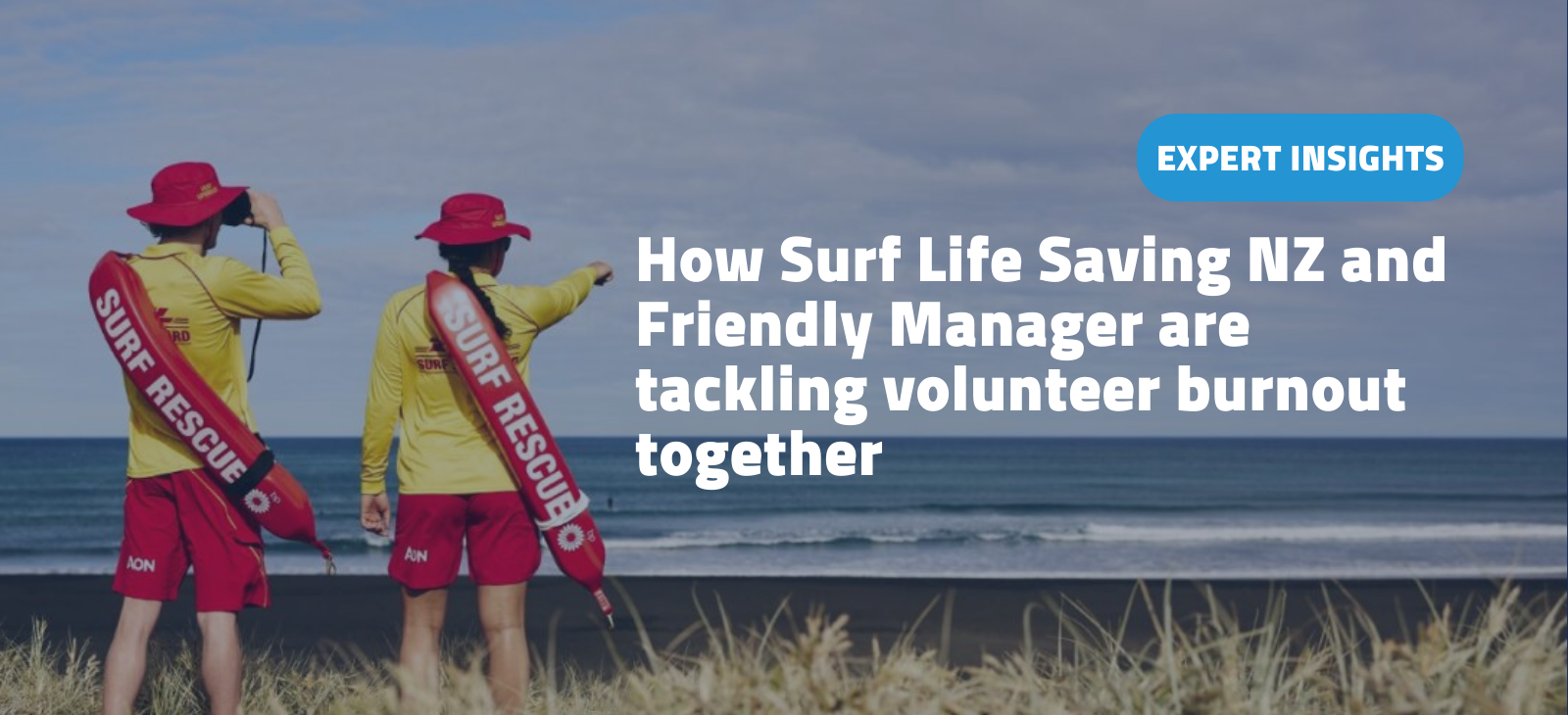
Volunteer burnout is one of the most persistent, yet least talked-about, challenges facing community organisations. For Surf Life Saving New Zealand (SLSNZ), an organisation built on the dedication of volunteers, the issue isn’t abstract.
“It’s something we see at club level every day,” says Chris Emmett, General Manager of Club Support and Capability at SLSNZ. “Addressing these pressures proactively is critical to volunteer satisfaction, and the long-term mission of keeping New Zealand’s beaches safe.”
That belief sits at the heart of SLSNZ’s new national partnership with Friendly Manager, selected through a competitive RFP process to become the club management software of choice, supporting all 74 Surf Life Saving clubs across Aotearoa, as well as SLSNZ as the national sporting organisation (NSO).
Emmett recently completed a Master’s High Impact Project focused on volunteer burnout within Surf Life Saving. The research now directly informs how the organisation approaches systems, support, and strategy.
“We’ve known burnout has been an issue for a long time,” Emmett says. “What the research allowed us to do was narrow down to where the pressure points really are and provide practical recommendations for moving forward.”
The research combined quantitative survey data from hundreds of volunteers with in-depth qualitative interviews. While administrative and compliance burden emerged as contributors, the biggest driver surprised many.
“The largest driver of volunteer burnout in our organisation was actually interpersonal dynamics,” Emmett says. “That included club politics, strong personalities, and generational challenges.”
When people are under pressure, unclear systems and duplicated work become flashpoints for conflict.
Surf Life Saving clubs span a wide demographic, from long-serving volunteers to younger members with digital-first expectations. When systems are complex or fragmented, those differences can be amplified, especially as increasing compliance requirements and disconnected platforms tip the balance toward administrative tasks, leaving less time for patrolling, training, or mentoring new members.
“Every extra platform, every spreadsheet, every workaround adds friction,” Emmett says. “And over time, that friction contributes to burnout.”
While technology can’t solve interpersonal dynamics on its own, Emmett believes it plays a powerful enabling role.
For a federated organisation like SLSNZ, with 74 clubs ranging from around 20 to more than 1,000 members, fragmented systems had become a growing issue. Clubs were using a mix of spreadsheets, standalone platforms, and partial integrations with national systems, creating duplication, inconsistency, and frustration.
“We had clubs managing membership in four or five different ways,” Emmett explains. “From an NSO perspective, that’s hard to support. From a volunteer perspective, it’s exhausting.”
By simplifying how clubs manage members, communicate, and meet compliance requirements, modern club management software can remove unnecessary frustration.
“When people are spending less time juggling spreadsheets, paper forms, and multiple platforms, it changes the experience,” Emmett says. “It reduces stress and helps people enjoy volunteering again.”
Emmett’s confidence in Friendly Manager is grounded not just in research, but also in his personal experience.
“I was Director of Junior Surf at my own club, Omanu,” he says. “I’ve seen the journey up close, how much time Friendly Manager saved administratively and how much easier it made things.”
Instead of managing paper sign-ins and scattered records, Emmett could see swim competency, medical information, and attendance in one place, even before the dedicated mobile app existed.
“I was using the website on my phone to check kids in and out,” he says.
For Emmett, those practical improvements show how Friendly Manager can be a genuine system-level solution to volunteer burnout, by removing friction from the parts of volunteering that drain energy.
When SLSNZ formally went to market, the criteria extended well beyond functionality.
The goal wasn’t to mandate a system from the top down, but to find a platform that worked not just for the national body, but for clubs and volunteers on the ground.
Friendly Manager was selected following a formal RFP process that included both national and global vendors. According to Emmett, several factors stood out.
“One of the biggest reasons was that clubs were already voting with their feet,” he says. “We already had around 25 clubs using Friendly Manager. That told us something.”
Club advocacy proved decisive. When Friendly Manager’s proposal was presented to club leaders at SLSNZ’s national conference, the response was overwhelming.
“We didn’t make the final decision until after that conference,” Emmett says. “The support from clubs was unanimous. That’s when we knew we were on the right path.”
Equally important was Friendly Manager’s approach to customer support and sector understanding.
“The priority for club care came through really loudly,” Emmett says. “It wasn’t just one person pitching. It was a team. Every team member understood surf clubs, volunteer environments, and the realities on the ground.”
Strong data security and risk management were also critical factors, alongside confidence in Friendly Manager’s product roadmap, including the mobile app, deeper integrations, and tools already in development.
More than anything, Emmett describes the SLSNZ–Friendly Manager relationship as a partnership grounded in shared values.
“Everything starts at the club,” says Rodd Penney, CEO of Friendly Manager. “Surf Life Saving runs on volunteers giving their time. Our responsibility is to make that experience easier and more rewarding at club level, because when clubs are healthy, it strengthens the entire organisation, right up to the national body.”
For Emmett, those values are most evident in how the rollout is being handled.
“We’re not forcing clubs onto a system,” he says. “We’re allowing them to come on at their own pace.
That flexibility matters in Surf Life Saving, where seasonality varies significantly across regions.
“Delivering on the beach always comes first,” Emmett says. “So the system has to fit around clubs, not the other way around.”
This club-up approach, rather than an NSO-down mandate, is central to why adoption is gaining momentum and why it’s expected to be more sustainable long term.
In te ao Māori, that idea is captured in the concept of kapa kotahi: one team, working together while respecting different roles, rhythms, and realities across the organisation.
“When decisions are made closer to the coalface, they stick,” Emmett says.

At a national level, the impact is transformative.
“Strategically, it’s about data,” Emmett says. “And bringing us into the modern world.”
Previously, membership information lived across multiple systems, limiting visibility and creating duplication. With Friendly Manager acting as a unified club management platform, records will flow seamlessly between clubs and the NSO.
“Getting everyone onto one platform removes so much unnecessary complexity,” he explains.
“Systems talk to each other in the background. Records are in one place.
“That gives us accurate, real-time insight into our membership,” Emmett says. “It improves planning, communication, compliance, and how we support clubs nationally.”
For clubs, the impact is far more practical than strategic.
Instead of juggling spreadsheets, paper forms, and disconnected systems, administrators can see memberships, qualifications, medical notes, and attendance in one place. Coaches and instructors can check who is qualified and who is due for refreshers. Volunteers no longer have to repeat the same information across multiple systems.
“Those are small things on their own,” Emmett says, “but together they remove a huge amount of friction from volunteering.”
Rather than rolling out in neat stages, the partnership is evolving on multiple fronts, reflecting the diversity of Surf Life Saving itself.
Clubs vary hugely in size, seasonality, volunteer capacity, and digital maturity, so a one-size-fits-all rollout simply wouldn’t work. While some clubs are ready to move quickly, others need time to build confidence and capability.
Future phases include expanded integrations, shared intranet resources, improved reporting, and tools that further reduce administrative burden for clubs of all sizes.
“In two years, I don’t think we’ll even blink,” Emmett says. “It’ll just feel normal, and that’s exactly the point.”

“We’re changing the foundations of our organisation,” Emmett says. “The constitutional project was the first big step. Friendly Manager is the second.”
For SLSNZ, the partnership with Friendly Manager is ultimately about protecting the people who make Surf Life Saving possible.
Through shared values, a club-first mindset, and a modern approach to club and member management, Surf Life Saving NZ and Friendly Manager are building a future grounded in kapa kotahi—one team, working together.
“If we want healthy, sustainable clubs,” Emmett says, “we have to make it easier to volunteer. Friendly Manager is a big step in that direction.”